SELLING YOUR DENTAL SCRAP
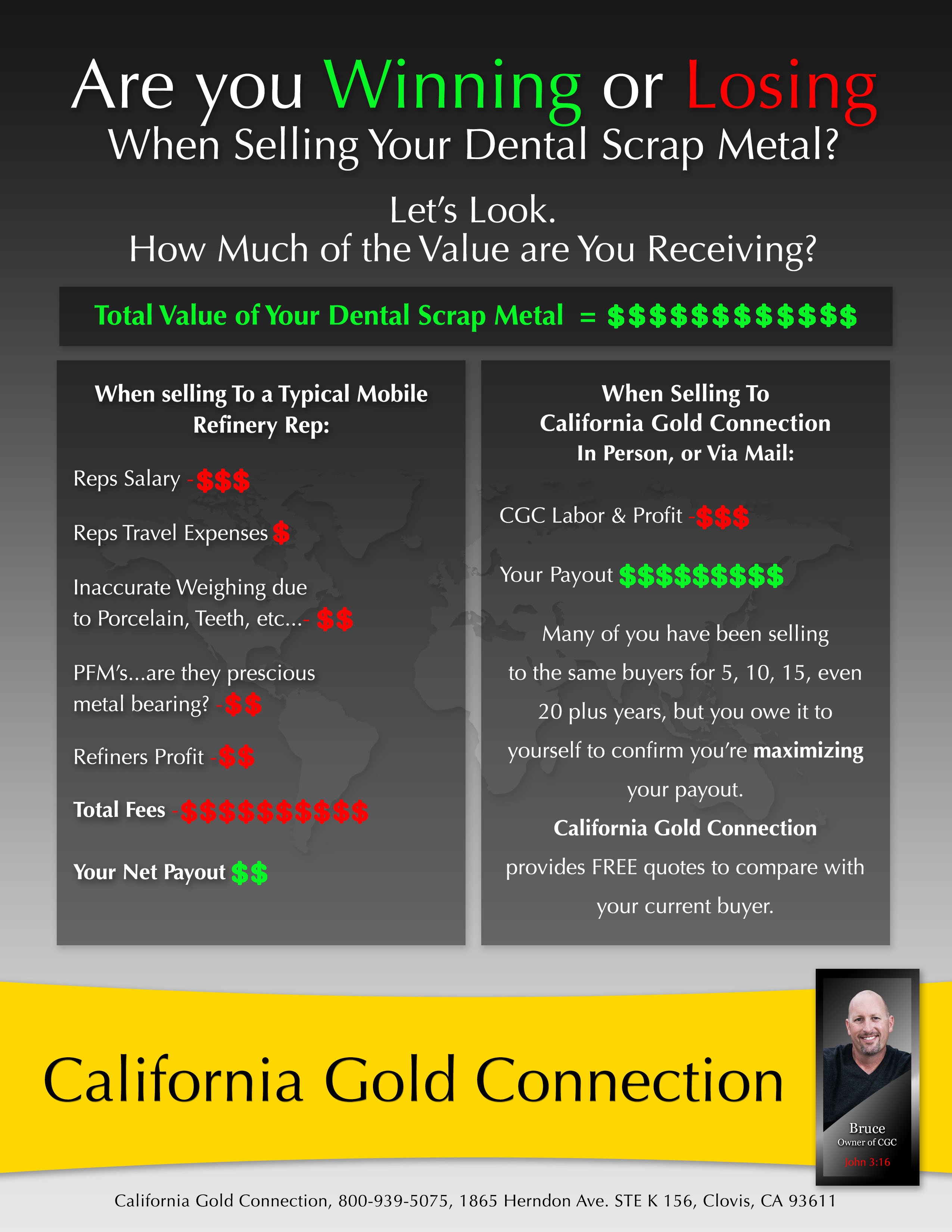
California Gold Connection buys dental scrap gold — crowns, bridges, PFMs, and more — for top dollar.
Why the Industry Standard May Be Costing You Money.
Watch the video below.
WHAT A COUPLE OF DENTISTS HAVE TO SAY...
NOT QUITE READY TO MAIL IN YOUR DENTAL SCRAP?
JOIN OUR MAILING LIST FOR MARKET PRICE UPDATES.
How Palladium makes a huge difference in your payouts.
The Challenge you have when selling to
"conventional mobile" buyers.
Below is an example of dental scrap (these pictures are of the same scrap) before and after cleaning. The weight after cleaning differs drastically from the weight before.
Therefore, mobile buyers must pay a very low average when just weighing your dental scrap gold in your office without cleaning and testing it, as they have no idea of the actual weight or quantities of the precious metals they are buying...it's all guesswork.
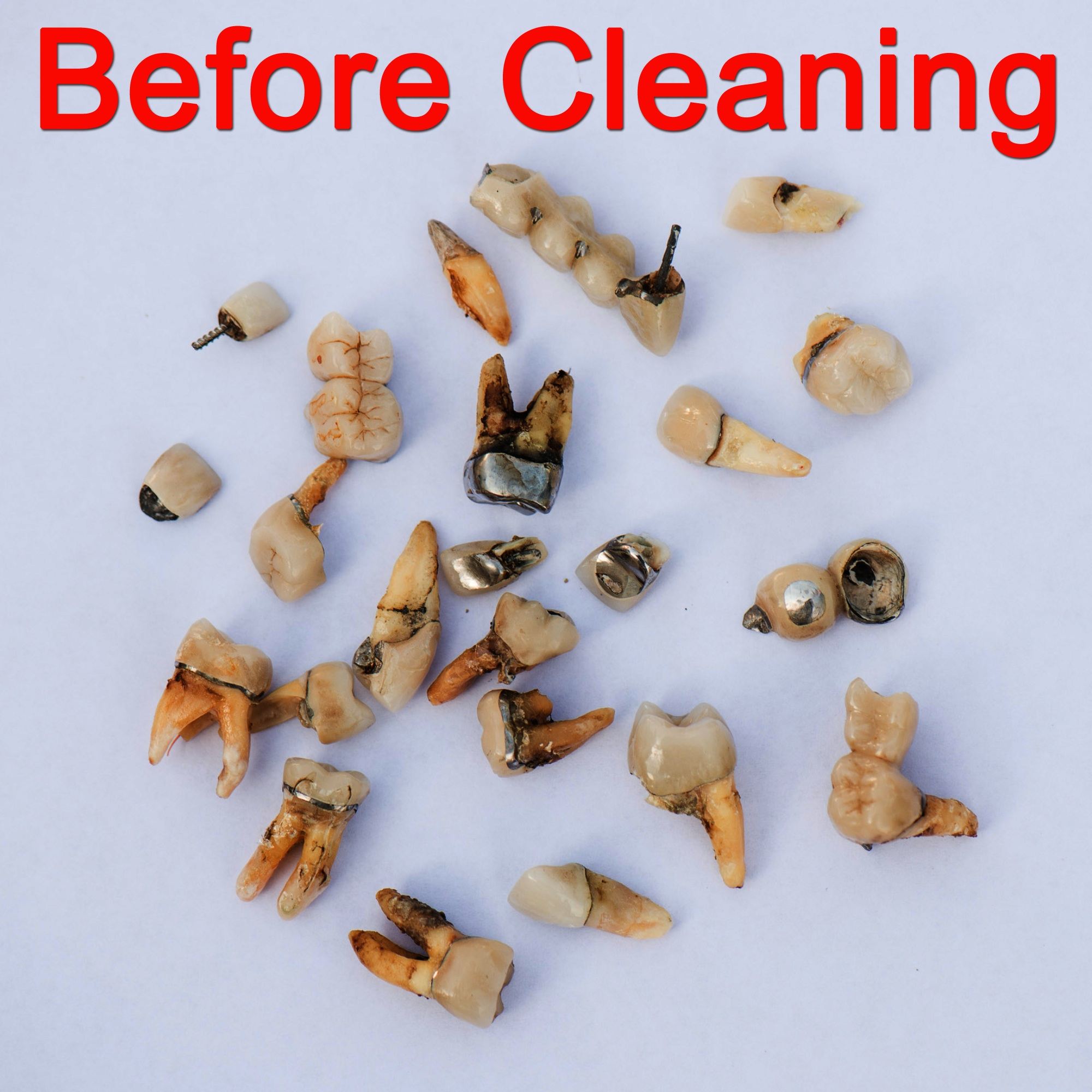
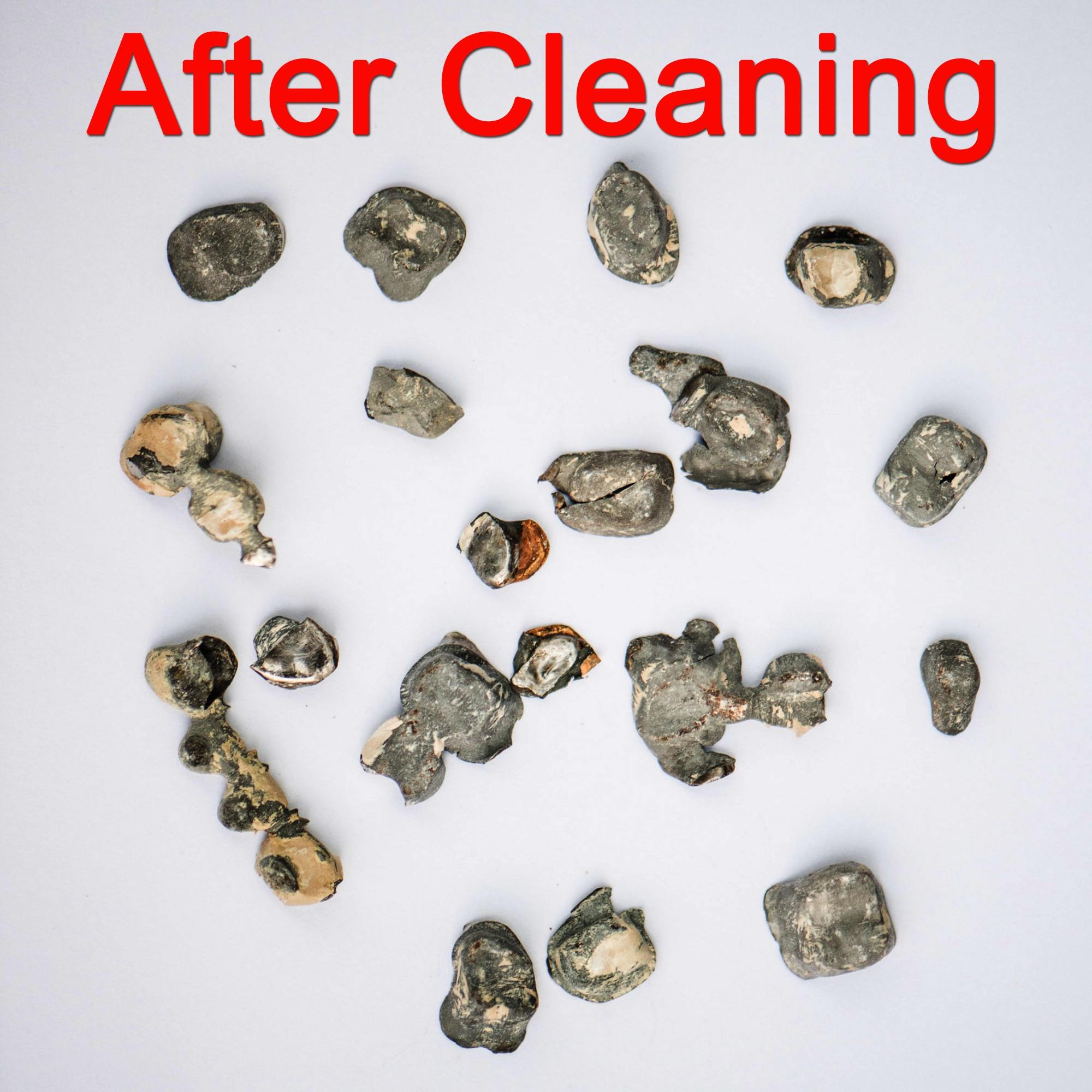
All precious metals are bought and sold by weight, so knowing the accurate weight is critical if a buyer is to pay you accurately... but that's only half the story when it comes to getting paid accurately for your dental scrap gold.
The other piece of the puzzle is what kind of alloy is actually underneath the porcelain on a PFM (porcelain-fused-to-metal) restoration — whether it's high noble (precious-metal bearing), semi-precious (noble), or non-precious entirely. Without knowing that, any offer is really just a guess. The only way to pay accurately is to clean and test the scrap, or melt it down and strip away everything that isn't payable metal. Estimating instead of testing is common in the industry, but common doesn't mean accurate.
Bottom line...guesswork = LOW PAYOUT!
Generally, mobile buyers price dental scrap using a worst-case-scenario estimate. When your scrap turns out to be high-quality, they come out way ahead; when it's genuinely low-grade, they still do very well. That's not necessarily dishonest — it's just how a buyer has to operate if they're pricing by eye instead of testing. It's the industry norm, and it's also exactly where California Gold Connection does things differently.
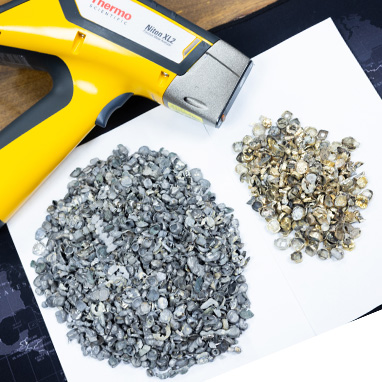
Below is an example of yellow-and-white dental scrap after cleaning. A good mobile buyer will at least separate the two categories. But even then, without actual cleaning and testing, yellow PFMs can be tough to tell apart from white alloys by sight alone — so they often just get grouped in with the white pile, and you lose value you never knew you had.
I'm often asked, "What can I expect from my dental scrap gold?"
When asked this question, as a rule of thumb, I look at two criteria: how old your practice is and what type of alloys you are installing.
If your practice is 10 years old or older, you're likely extracting work you previously installed. So, depending on the alloys you are using, i.e., non-precious, semi-precious, noble, or high noble, your scrap will follow suit, for the most part.
So, if you install mostly non-precious alloys, a large portion of your scrap will test non-precious, driving your payout down. On the other hand, if you install semi- or precious alloys, your scrap will be better overall.
Another variable is all the work you are extracting that was installed outside your practice… as you know, that can be just about anything.
Please keep in mind this is all speculation, but it can give you an idea of what to expect, good or bad.
SO HOW DOES CALIFORNIA GOLDCONNECTION DIFFER?
Once your dental scrap arrives, we process it in one of two ways, depending on which will yield the most accurate payout: we either clean each piece to bare metal and test it individually, or melt the full batch into a single bar for testing. Either way, it's a slow, hands-on process. If tested individually, we separate the non-precious material from the precious metal-bearing scrap, then weigh and pay based on what's actually there. For large volumes of small fragments, sweeps, or dust, melting the batch and testing it as a whole is typically the more practical route.
So why does California Gold Connection go through all this trouble?
Because it's how we compete. Taking the extra time to clean and test scrap individually — rather than estimating, as much of the industry does — lets us pay more accurately and usually more overall than a rough estimate would. Our goal isn't a one-time transaction; it's a client who keeps coming back.
We are often asked, what do we buy?
PFMs, PFGs, Crowns, Bridges, Inlays, Onlays, Partials, Gold-bearing dentures, Casting Ingots, and Sprues; basically, when in doubt, send it in, and we will test it and pay you accordingly!
PAYOUT OPTIONS
Once our cleaning and testing process is complete, we will call, text, or email you with our quote, whichever you prefer, to make sure you are happy. If so, we will pay you in one of 3 ways:
- Cashier’s Check – Made out to the name of your choice, and mailed to the address you provide.
- Zelle - This generally works better for smaller amounts.
- Wire - Good for large amounts.
Thank you in advance for choosing California Gold Connection as your dental scrap buyer; we look forward to taking care of you.
Dental Scrap Metal FAQ:
Everything You Need to Know Before You Sell!
What exactly counts as "dental scrap metal?
Dental scrap metal is the general term for any leftover metal material from dental work that still contains recoverable precious metal. Think crowns, bridges, inlays, onlays, and partial frameworks that have been removed, replaced, or never used. It also covers less obvious sources like casting sprues, buttons left over from lab work, and even the fine metal dust collected in bench and floor sweeps and in vacuum filters at a dental lab. If it came out of a dental office or lab and has any gold, silver, platinum, or palladium content, it qualifies as dental scrap.
Which precious metals are dentists and labs actually sitting on?
Most dental scrap value comes down to four metals: gold, palladium, platinum, and silver. Gold has historically been the workhorse for crowns and bridges because it's durable and biocompatible. Palladium and platinum often show up in "white" or silver-colored dental alloys, which is why scrap that looks like plain steel sometimes turns out to be worth far more than it appears. In practice, gold and palladium do most of the heavy lifting in terms of value; platinum and silver are typically present, but in much smaller amounts.
My crown looks silver, not gold — is it still worth anything?
Possibly, and this trips people up all the time. Color is not a reliable way to judge value. All dental alloys fall into one of three categories: non-precious, noble (25% or more precious metal content), or high noble (60% or more in precious metal content). The only accurate way to know what you're holding is to have a professional test it. Don't toss anything just because it doesn't look "gold enough."
What items should I be saving instead of throwing away?
- The list is broader than most people expect:
- Full and partial crowns
- Bridges
- Inlays and onlays
- PFM (porcelain-fused-to-metal) restorations — the porcelain gets burned off during processing, so it doesn't disqualify the piece
- Casting sprues, buttons, and lab scrap
- Metal filings and grindings
- Bench sweeps, floor sweeps, and vacuum bag contents from a dental lab
What dental scrap gold won't a refiner take, or pay for?
A few materials come up repeatedly, and it's worth knowing them up front: amalgam (it contains mercury and must be handled through specialized hazardous-waste channels, not standard refining), lead, titanium, and most chrome-cobalt alloys. Titanium and chrome-cobalt aren't refused because they're "bad" — they simply don't carry any precious metal content, so there's nothing to recover.
Do partial dentures have any value?
It depends entirely on the metal framework, not the plastic or acrylic parts. If the metal shows a yellowish tone, there's a reasonable chance it contains recoverable gold. If the framework is plain silver-gray, it's almost certainly a cobalt-chromium or titanium alloy with no precious metal content. When in doubt, send it in — a proper assay will settle the question either way.
Do I need to remove teeth, porcelain, or cement before sending dental scrap gold in?
No. Attached teeth, porcelain, and residual cement are handled during the melting stage, where non-metal materials burn off and separate from the metal. You don't need to clean, sort, or pre-process anything before shipping it to a refiner. If you're a dentist with an autoclave, it's a good practice to run it through, but it's not necessary if you don't have one.
Is there a minimum quantity required to sell dental scrap gold?
Generally, no —most refiners will process small batches without a minimum. That said, combining scrap into fewer, larger shipments over time is usually smarter, since it reduces shipping hassle and lets you see the full picture of what a batch is worth in one payout rather than several small ones. If you are not a dentist and are just sending in a few personal pieces, definitely review the mail-in instructions on your scrap page for proper shipping instructions.
How does a refiner figure out what my dental scrap gold is worth?
The process is essentially melt, assay, and pay. Your scrap is melted down into a homogeneous batch, a sample is tested (assayed) to determine the exact percentage of precious metals present, and payment is calculated based on that verified purity and the current market price for each metal. This is why the payout is based on the actual recovered content, not a guess about what a piece "should" contain.
Why is my payout lower than what similar gold sells for retail?
Retail jewelry and dental pricing includes labor, design, and markup, which have nothing to do with raw metal content. A refiner pays based only on the value of the melted, pure metal — which is a fundamentally different number from what a finished piece would sell for in a showroom. This is standard across the refining industry, not something specific to any one buyer.
How long does it take to get paid after sending in dental scrap gold?
Timelines vary by refiner, but a common turnaround is a few weeks from when the scrap is received to when payment is issued. Some refiners offer expedited processing for an additional step or fee if you need a faster turnaround. While those are the industry averages, here at California Gold Connection, if you let me know it's coming, I put you in line for as immediate processing as possible.
What if I don't like the offer — can I get my dental scrap gold back?
Yes. If our offer doesn't work for you, we'll return your scrap at no cost. One thing worth knowing upfront: because sorting and evaluating your scrap takes real time and expertise on our end, a returned batch comes back as one unsorted bag rather than pre-sorted by metal type. We're glad to hand your scrap back — we just don't hand over the sorting work along with it.
Is selling dental scrap metal legal, and is it safe for the environment?
Yes, and recycling it is actually the environmentally responsible option. Precious metals from dental work can contaminate water systems if they're thrown in the trash or washed down a sink. Proper recycling keeps those metals out of the waste stream and returns value to the dentist, lab, or patient instead. Regulations around handling do vary by state, particularly for amalgam and fine metal dust, so it's worth checking local requirements if you're processing scrap at a practice or lab level.
Can patients sell their own extracted crowns, or is this just for dental offices?
Both. Individual patients who've had a crown, bridge, or other metal restoration removed can sell it directly, and dental offices and labs can do the same at a larger scale through ongoing collection programs. The evaluation and payout process works the same way regardless of whether you're sending in one crown or a year's worth of dental scrap.